

Scirocco 2000 | DN25 to DN600
Product Description
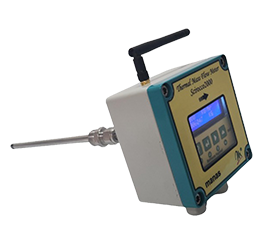
Manas Microsystems offers the Scirocco 2000 Insertion Type Thermal Mass Flow Meter for precise industrial gas and compressed air mass flow measurement. It delivers direct mass flow measurement, instantaneous flow rate and totalized consumption for energy-saving and process-quality applications.
Designed for dry, clean compressed air and gases such as CNG, O2, PNG and N2, the meter uses a no-moving-parts sensor for low maintenance and vibration-resistant service. Pressure and temperature fluctuations do not require separate compensation for the stated application conditions.
Working Principle
An insertion thermal mass flow meter measures gas mass flow by sensing how flowing gas removes heat from a heated sensor.
When gas passes over a heated element, forced convection carries heat away. The temperature change is related to mass flow, allowing the meter to calculate flow rate without separate pressure or temperature compensation.
The sensor has no moving parts, so routine care is limited to occasional cleaning with compressed air in suitable dry and clean gas service.
Direct measurement of mass flow for industrial gases.
No pressure or temperature compensation required.
40:1 turndown ratio for a wide measuring range.
Easy-to-clean insertion sensor with no moving parts.
Remote readings available on mobile app.
Pulse, mA or RS485 output for networking.
Fast response for air and gas measurement.
Flexible insertion and mounting length options as specified by Manas.
Selection Assistant
Select line size and gas service to surface the installation and output details that matter most for insertion-type thermal mass flow measurement.
Line size band
Gas service
Installation focus
Standard insertion setup for utility headers
Service recommendation
Dry, clean compressed air consumption monitoring
Output package
Pulse, mA or RS485 for networking
Maintenance note
No moving parts; occasional sensor cleaning with compressed air
Principal Benefits
One insertion-style meter can suit a range of pipeline sizes when the same medium is flowing, reducing product selection complexity.
Direct gas mass flow data helps teams monitor compressed air and fuel gas usage for process improvement and energy saving.
No moving parts means less wear and better immunity to vibration compared with many mechanical meter types.
Pulse, mA and RS485 output options make the meter practical for totalizers, PLCs and plant monitoring systems.
Applications
Use Scirocco 2000 where large-pipe gas measurement, easy installation and direct mass flow visibility are important.

Monitor consumption across headers, utility lines and production departments.

Measure gas flow where pressure is low but direct mass flow visibility is still required.

Use known gas properties to support fuel gas consumption measurement and control.

Track gas usage during engine testing and performance validation.

Measure and control oxygen flow for industrial process lines.

Monitor biogas generation and usage where gas properties are known.
Installation Flow
The source installation method is straightforward: insert, screw, align, connect and commission after ensuring the required straight run.
Weld the socket on the gas pipeline or duct at the selected measuring point.
Insert and screw the sensor into the socket.
Align the sensor as instructed in the installation manual.
Ensure the required straight pipe length on both sides of the sensor.
Connect the sensor to the electronics and commission the display/outputs.
Technical Data
Standard details from the product page are summarized below. Final selection should confirm gas properties, line size, straight length and process conditions.
Specifications are subject to change without prior notice.
Direct answers for engineers evaluating insertion type thermal mass flow meters for gas pipelines and ducts.
Verified by Manas Engineering
ISO 9001:2015 company with industrial gas flow measurement expertise