

Large Pipes • Hot-Tap Ready • Direct Mass
Direct Answer
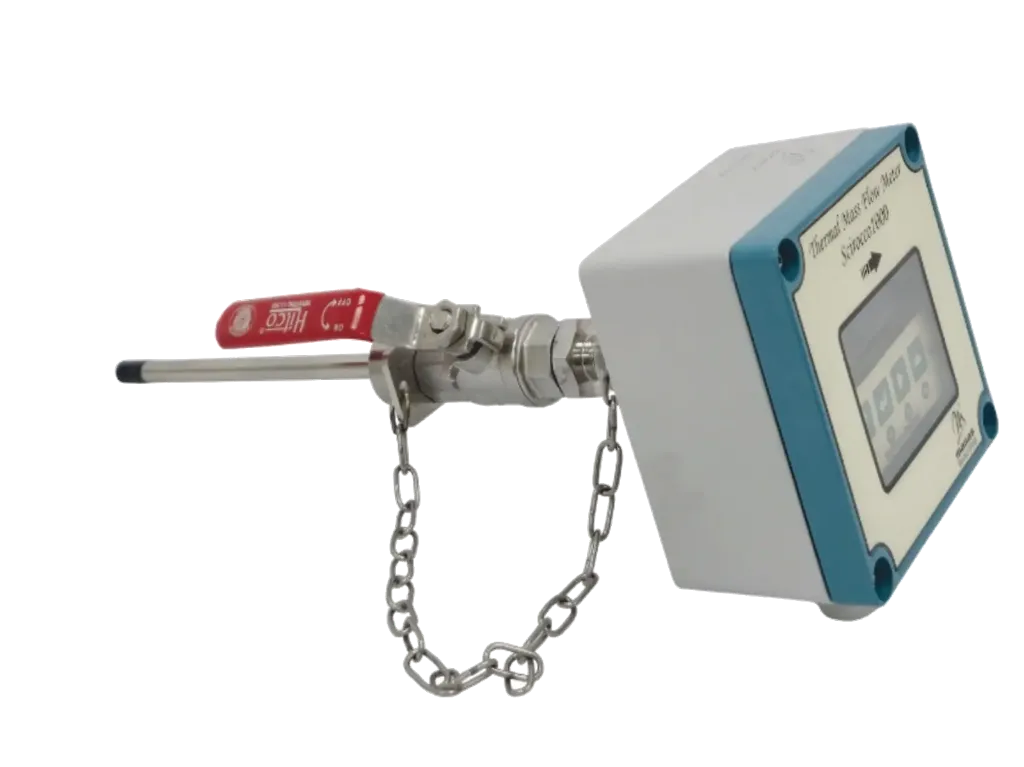
An Insertion Type Thermal Mass Flow Meter is a specialized gas measurement device designed for large-diameter pipes and ducts. By inserting a dual-sensor probe directly into the flow stream, it delivers highly accurate, direct mass flow measurement without requiring the extensive costs and downtime associated with cutting into pipes for inline meters.
Technical Deep-Dive
Understanding how dual-sensor probe technology captures mass flow directly.
The unheated Platinum RTD sensor continuously monitors the actual gas temperature, providing a reliable baseline regardless of process fluctuations.
A second Platinum RTD is actively heated to maintain a constant temperature differential (overheat) above the reference sensor.
As gas molecules flow past the probe, they carry heat away from the velocity sensor. The electrical power required to maintain the constant temperature difference is directly proportional to the mass flow rate.
Because the rate of heat dissipation relies on the specific heat properties and the number of gas molecules striking the sensor, the meter measures mass flow directly.
This thermodynamic technique eliminates the complex equations and cumulative errors associated with volumetric meters that require separate temperature and pressure transmitters.
Where Power (Q) is proportional to Mass Flow (ṁ).
Comparative Advantage
When dealing with large diameter pipelines (above 3 inches), insertion probes provide unmatched economic and operational benefits.
Inline meters become exponentially more expensive as pipe diameter increases. An insertion probe requires only a single access port, drastically reducing hardware and installation costs for large ducts and stacks.
Equipped with a retractor mechanism and isolation ball valve, the meter can be inserted, calibrated, or removed for maintenance without depressurizing the line or halting critical plant processes.
Unlike orifice plates or vortex shedders that obstruct the flow path, the slender profile of an insertion probe creates virtually zero pressure drop, conserving compressor energy and lowering operational costs.
Engineering Documentation
Every insertion probe is manufactured to withstand harsh industrial environments while delivering pinpoint accuracy.
Multi-point gas calibration performed in advanced wind tunnels using NIST Traceable standards to ensure absolute compliance with international metrology requirements.
Probe stems and wetted parts are constructed from robust 316L Stainless Steel, ensuring longevity and resistance to corrosive gas streams like flare gas or biogas.
Designed for pipelines up to 1000mm and beyond, with hazardous area ATEX / Exd enclosure options available.
Technical guidance for systems integrators and mechanical engineers.
Verified by Manas Engineering
Technical Authority in Flow Measurement Integration